Caldwell, ID Sunday, 9/21
After washing the baby while we were Medora, ND it had to rain on us. It rained on Saturday, Sunday, and of course Monday, when we left. Despite our best efforts, we always end up with a dirty coach.
Entering Montana, the rain started slowing down a bit and we came to a real Wizard of Oz scene. With sunflowers to North of us and a rainbow out in front, it was truly a magical moment.
Montana is a really large state but since we hadn't seen any of it before, we debated taking the northern route across US 2 or taking the interstate route using I-94 and I-90. We took the easy, but longer route - the interstate.
From ND to Billings, MT followed the Yellowstone River. Wide valleys, lots of ranching and farming, beautiful river. We stayed on the other side of Billings the first night (Billings is pretty ugly looking with oil refineries and industry) at a small campground close to a Flying J in Columbus, MT. We got up the next morning and headed for Missoula, MT.
We were greeted with some snow on the higher peaks (we think these are the Big Horn Mountains that extend south into Wyoming, bright sunshine, and the Yellowstone river. If that picture doesn't say Montana, I don't know what else could.
Before we left South Dakota, we had purchased a new SatNav system for the motorhome - a Garmin 760RV. We had only used it to get to Medora, ND and so this was its really big test. With all SatNav systems it's always helpful to have a back-up. Our backup for this trip was:
Sam, our CatNav system. He got us to Missoula, the Flying J, and Jim and Mary's RV park just fine.
After a nice overnight at Jim and Mary's we were off to Coram, MT and the North American RV Park for our stay at Glacier. The NARVP is only about 6 or 7 miles from the park entrance and it worked out well for us.
Our first afternoon, we headed for Glacier for a little scouting trip. We wanted to make sure we knew where everything was because we had scheduled a tour for the next morning. After locating our meeting spot, we took a drive up the shores of Lake McDonald for our first look at Glacier.
After this scene, I was ready for the tour on the famous
We had selected the all day tour and were ready to go - the next morning at 8 am.
Sunday, September 21, 2014
Tuesday, September 16, 2014
Posts delayed again - but we have a reason, honest!
Caldwell, ID Ambassador RV Resort September 16th
Between driving to Glacier National Park, seeing GNP, and then driving to Idaho, we've been busy, busy, busy. We also have a new addition to our family who has also consumed a large amount of time.
I'll be catching up with GNP posts over the next week or so. What a fabulous place to visit.
Introducing the fabulous Miss Zoe:
| I think we wore each other out. |
Zoe was officially rescued from Idaho Humane Society on 9/11 although we found her on the 10th. We couldn't take her home at first because we hadn't taken the bikes out of the car and there was no room (and we had zero in the way of dog stuff after Gabi's passing). So good things can happen on that day. She was found wandering as a stray but her original owner was located and he declined to take her back. The Humane Society was told that she was a Doberman/Lab mix, a year old, was crate trained, got along with cats, and had some obedience training.
What we know about her (after a week): She is fine with the cats, is crate trained, and is smarter than all get out and learns very quickly. We've got Sit, Off, and Come down cold and we are working on Heel, Down and Stay. Not bad for less than a week.
We are not sure about the Doberman part as she looks and acts Lab all the way except that she is more mature than a one year old lab. She is skinny, about 60 lbs, but is healthy. She apparently was not well socialized with people (she will hide behind us) as well as other dogs but she is coming out of her shell slowly.
Hello from the other Badlands
Medora, ND From Glacier National Park, Saturday, August 30th
Medora is the home of Theodore Roosevelt National Park. Roosevelt played a huge role in preserving the West for us "future generations" to enjoy. Roosevelt had a strong connection to area around Medora, the Little Missouri River, and the Badlands as he chose this area to put his life back together after the death of his first wife. This area is really dedicated to the cowboy.
In the 1880's most cattle were driven market or two a railhead to be shipped to large city (such as Chicago) for processing into beef. Medora was founded in 1883 along the transcontinental rail line of the Northern Pacific Railway by French nobleman Marquis de Mores, who named the city after his wife Medora von Hoffman. Marquis de Mores wanted to ship refrigerated meat to Chicago via the railroad. He built a meat packing plant for this purpose and a house named the Chateau de Mores, for his Summer guests. After losing a reported $1.5mm (really big bucks in the 1880s), de Mores packed it in and moved back to Europe. His wife and son maintained the house until it was sold to the state and preserved. All that remains of the meat processing operation is the smoke stack.
Our exploring was shortened a bit by the weather (rain) and we were not able to travel to the North Unit of the park. So we hunkered down until we left for Montana and Glacier National Park.
Medora is the home of Theodore Roosevelt National Park. Roosevelt played a huge role in preserving the West for us "future generations" to enjoy. Roosevelt had a strong connection to area around Medora, the Little Missouri River, and the Badlands as he chose this area to put his life back together after the death of his first wife. This area is really dedicated to the cowboy.
In the 1880's most cattle were driven market or two a railhead to be shipped to large city (such as Chicago) for processing into beef. Medora was founded in 1883 along the transcontinental rail line of the Northern Pacific Railway by French nobleman Marquis de Mores, who named the city after his wife Medora von Hoffman. Marquis de Mores wanted to ship refrigerated meat to Chicago via the railroad. He built a meat packing plant for this purpose and a house named the Chateau de Mores, for his Summer guests. After losing a reported $1.5mm (really big bucks in the 1880s), de Mores packed it in and moved back to Europe. His wife and son maintained the house until it was sold to the state and preserved. All that remains of the meat processing operation is the smoke stack.
| North Dakota, South Dakota?? It's all flat (but greener) in those states. This was on the way to Medora. |
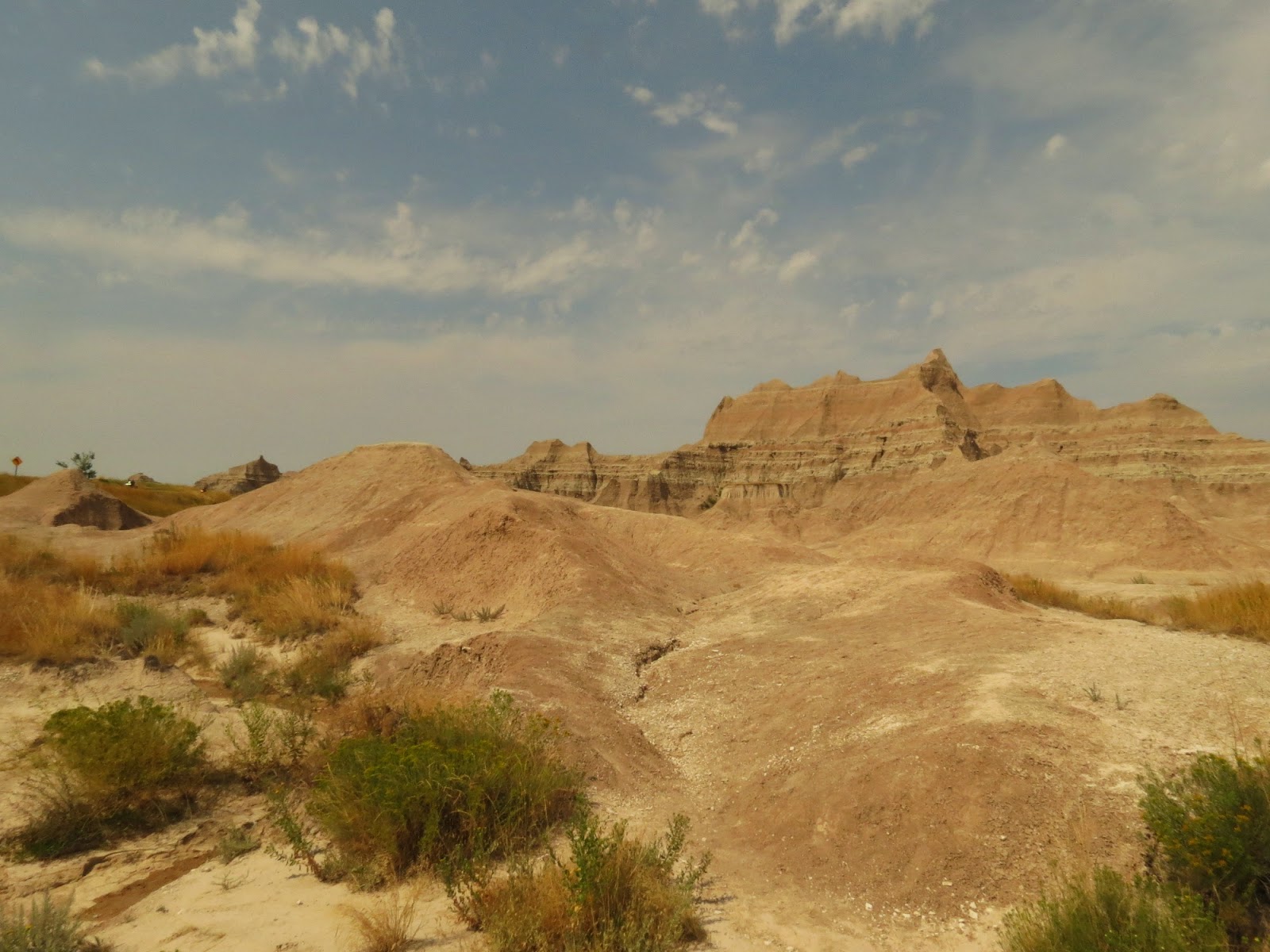
North Dakota Badlands
| Looking across the non-tourist section of Medora towards our campground. We were at the base of that bluff in the center of the picture. |
Theodore Roosevelt National Park
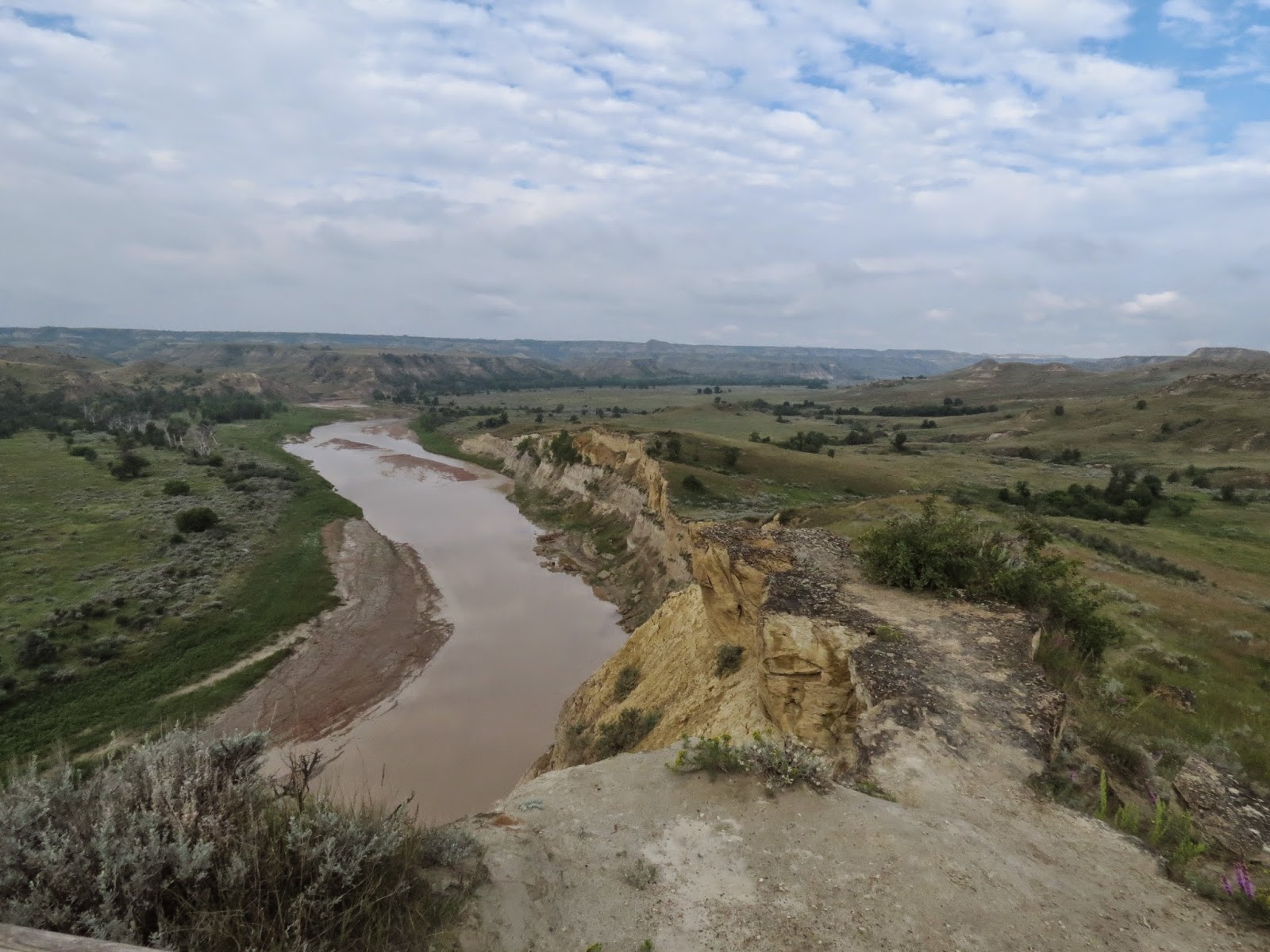
| Wind/water erosion on a bluff above the Little Missouri River |
| Little Missouri River |
| Another prairie dog. They were just about the only things stirring the morning we took a drive on the wildlife loop. Until the end... |
de Mores State Historical Site
I should mention that we did attend the really big Medora attraction - the Pitchfork Fondue and Medora Musical. Quite a production and a must see in Medora.Our exploring was shortened a bit by the weather (rain) and we were not able to travel to the North Unit of the park. So we hunkered down until we left for Montana and Glacier National Park.
Saturday, August 30, 2014
Saying Goodbye to South Dakota
From Glacier National Park, Saturday, August 30th.
We had originally planned on staying only 2 weeks in South Dakota. We had some legal things to do (our wills) and still had things we wanted to go see in the area. After two weeks, we still had things we wanted to see in the area. The Black Hills area has at least a month worth of things to see and do - and that doesn't include the commercial attractions. So we stayed and played some more.
Our last week in SD and Rapid were not without some some fun.
Views from Iron Mountain Road (taken from various turnouts)
Views from The Needles Highway
We pulled the slides in, put the satellite antenna down, and hoped the hail didn't cause too much damage.
The biggest pieces were about golf ball size but most of it was small, pea sized hail. Sounded pretty dramatic hitting the roof of the motorhome. The storm was moving so fast that it didn't last too long and no damage was done.
And finally, bye from South Dakota.
We had originally planned on staying only 2 weeks in South Dakota. We had some legal things to do (our wills) and still had things we wanted to go see in the area. After two weeks, we still had things we wanted to see in the area. The Black Hills area has at least a month worth of things to see and do - and that doesn't include the commercial attractions. So we stayed and played some more.
Our last week in SD and Rapid were not without some some fun.
Badlands Redux
We had planned to visit the Minute Man 1 historic site just outside of the Badlands National Park. Part of the draw is the descent into an actual control bunker (now decommissioned) that was used during the Cold War. The number of people allowed on a tour is very limited and when we got to the park "headquarters" (two trailers behind a gas station) we could not get tickets for that day. What to do. Well the main Badlands park entrance was just a few miles away so off for a quick transit from East to West.| Just a reminder of what the SD Badlands look like. |
| We went looking for buffalo (bison to you purists) and found big horn sheep instead. Who would have thought you would have found these on the plains. |
![]() |
| Mom and baby big horns. These crossed slowly in front of the car a few minutes later. |
Custer State Park Redux
Custer State Park might be one of the best parks for tourists to enjoy. Great wild animal viewing, scenic drives that you truly talk about for years, and very memorable National Monuments.Views from Iron Mountain Road (taken from various turnouts)
| Taken from the base of Mt. Rushmore |
![]() |
| Cars are not a problem. |
Time to leave
SD gets some pretty wild storms but we had missed most of them. One of the worst ones occurred when we were in Scottsbluff. But this one was a at least a close second. As soon as the radio started yelling at us, I stepped outside to this:We pulled the slides in, put the satellite antenna down, and hoped the hail didn't cause too much damage.
The biggest pieces were about golf ball size but most of it was small, pea sized hail. Sounded pretty dramatic hitting the roof of the motorhome. The storm was moving so fast that it didn't last too long and no damage was done.
And finally, bye from South Dakota.
Tuesday, August 12, 2014
Devils Tower
Tuesday, August 12, Hermosa, SD
(images have not been resized - click on them for hi-res views)
A couple of weeks ago, we awoke to a great day of sunshine and moderate temperatures and decided to take a road trip to Wyoming and Devils Tower National Monument - yes, the same one in Close Encounters of the Third Kind. But first, a stop at a couple of unknown Wyoming treasures.
This was discovered in the late 1960s during the construction of I-90. Even the Vore family who owned the land didn't know what they had. Surveyors discovered a sink hole right in the middle of the prospective highway. The Vore family had used it as trash dump (what else do you do with a big hole in the middle of your property) and the road guys figured they had better do some investigations before the just filled it in and paved it. They did some test bores and discovered a bone pile that dated back to the 1500s when the native americans first started using it to harvest buffalo. The layers are so distinct that the exact years it was in use can be established. Native americans stopped using this harvest method when they obtained firearms in the 1800s.
The area is administered by the Vore Buffalo Jump Foundation and is an active training site for archeology students. The estimate is that 20,000 buffalo were harvested here during the 300 years it was in use. The Plains indians relied heavily on the buffalo as a source of food, shelter, clothing.
The tower is a product of erosion. While the material that makes up the tower is igneous in origin, it was thought to never have reached the surface. This area was once part of an inland sea and was eroded by water and wind. The tower, being of much harder material was revealed over hundreds of millions of years.
The first national monument in the United States was named in 1906 by President Theodore Roosevelt - Devils Tower. The Tower also plays a significant role in Native American history and lore and is considered a sacred site to some tribes. By the way, the name, Devils Tower, was the result of a bad translation into English by an early explorer.
Devils Tower is very popular with climbers. It was first climbed in the 1890s using a 300' long wooden ladder. The first technical climb was in 1937. We noticed this young women at the top when we were eating lunch in the picnic area.
And these climbers at the top of a column ready to start their assent.
You can easily get a 360 degree perspective of the tower by taking the 1 mile hike around the base.
A trip to a National anything around these parts wouldn't be complete without a visit to the prairie dog village. Cute, social, and very protected within National Park or Monument borders, these guys are everywhere.
(images have not been resized - click on them for hi-res views)
A couple of weeks ago, we awoke to a great day of sunshine and moderate temperatures and decided to take a road trip to Wyoming and Devils Tower National Monument - yes, the same one in Close Encounters of the Third Kind. But first, a stop at a couple of unknown Wyoming treasures.
Vore Buffalo Jump
First stop was the Wyoming Welcome Center. No pictures (unless Mary put it on Facebook) but a great stop. A bit of a museum, nature center, and tourist promotion kiosk. Whatever it was, it was done right. If you are traveling on I-90 in Eastern Wyoming, you should stop. The second was something we didn't anticipate - The Vore Buffalo Jump.This was discovered in the late 1960s during the construction of I-90. Even the Vore family who owned the land didn't know what they had. Surveyors discovered a sink hole right in the middle of the prospective highway. The Vore family had used it as trash dump (what else do you do with a big hole in the middle of your property) and the road guys figured they had better do some investigations before the just filled it in and paved it. They did some test bores and discovered a bone pile that dated back to the 1500s when the native americans first started using it to harvest buffalo. The layers are so distinct that the exact years it was in use can be established. Native americans stopped using this harvest method when they obtained firearms in the 1800s.
![]() |
| Active digging area |
![]() |
| Buffalo skull |
Devils Tower
After the nice, unexpected break, we set off for Devi's Tower. This really should be on your "Do not miss" list of North America. The drive to the tower is beautiful - the high northern plains remain easy on the eyes with grasslands and pine trees making you wish you could just stay there all year.| First siting |
| Just a few miles away |
| Still about a mile from the entrance |
| Climber at the summit |
| Climbers in route |
![]() |
| View from the trail around the base |
![]() |
| Remnants of the wood ladder used to scale the dome the first time |
![]() |
| View from the prairie dog village |
| Prairie dog |
Monday, August 11, 2014
Back to Nebraska
Monday, August 11
My retirement "job" is doing presentations to my fellow diabetics about how to do a better job managing their diabetes. I've been managing my diabetes successfully since 1990 and it really isn't that big of deal - if you want to. Diabetes is, in fact, my favorite chronic disease. Why? Because you can manage it yourself without a lot of intervention from your medical professionals. Equipped with my glucose meter and my smart phone (and most recently my insulin pump) I've got everything I need to keep my blood sugar in my target range.
So, we (Mary got to go with me on this one) headed back to Nebraska, sans the RV, to do a program for the local hospital in Scottsbluff. And what is Scottsbluff famous for? This...
Hopefully you learned about the great westward migration when you were in school. Scottsbluff was a major resting/re-provisioning stop over for Oregon Trail, Mormon Trail, and California Trail. Most wagon trains left from Independence, MO and surrounding areas and headed to this area. Approximately 625 miles by highway today, the original trails followed rivers - the Missouri and the Platte to reach the area. If you were on this great adventure, you walked - about 15 miles a day, every day, for a couple of months.
You can learn much more about the whole westward migration at the visitor's center at memorial.
The other major landmark to the migrants was Chimney Rock. This formation is about 20 miles south and east of Scottsbluff and also signaled that they were close to their destination.
And back to Hermosa, SD after our visit.
My retirement "job" is doing presentations to my fellow diabetics about how to do a better job managing their diabetes. I've been managing my diabetes successfully since 1990 and it really isn't that big of deal - if you want to. Diabetes is, in fact, my favorite chronic disease. Why? Because you can manage it yourself without a lot of intervention from your medical professionals. Equipped with my glucose meter and my smart phone (and most recently my insulin pump) I've got everything I need to keep my blood sugar in my target range.
So, we (Mary got to go with me on this one) headed back to Nebraska, sans the RV, to do a program for the local hospital in Scottsbluff. And what is Scottsbluff famous for? This...
| Scottsbluff National Monument |
Hopefully you learned about the great westward migration when you were in school. Scottsbluff was a major resting/re-provisioning stop over for Oregon Trail, Mormon Trail, and California Trail. Most wagon trains left from Independence, MO and surrounding areas and headed to this area. Approximately 625 miles by highway today, the original trails followed rivers - the Missouri and the Platte to reach the area. If you were on this great adventure, you walked - about 15 miles a day, every day, for a couple of months.
You can learn much more about the whole westward migration at the visitor's center at memorial.
| There are actually two bluffs which form a pass through the area. This is to the left with Scottsbluff to the right. |
| Chimney Rock Visitor Center |
And back to Hermosa, SD after our visit.
Subscribe to:
Posts (Atom)